

Some characters endure because of the long history of comics, and then there are characters who define what a comic can be. Jean Grey is the latter. She is one of Marvel’s most powerful mutants, one of its most tragic figures, and for many readers an inspiration. Whether you met her in the pages of comics, in an animated cartoon or a movie, you may be familiar with some of her story. But for those just getting acquainted, here’s where it all begins.
A Psychic Prodigy
Jean Grey was born in Annandale-on-Hudson, New York, to John and Elaine Grey. One of two children, she had what seemed like a perfectly ordinary childhood until, at age ten, her best friend Annie Richardson was struck by a car. This was the trigger to her mutant psychic abilities. Jean, powerless to stop Annie’s death, instinctively reached out with her mind and felt everything Annie felt in those final moments. The experience was devastating and traumatizing.
Jean is both a telepath and a telekinetic. She can read and project thoughts, communicate mind-to-mind, and move objects with the force of her will alone. As mutant gifts go, they sound extraordinary. But for a child who couldn’t yet control them, being bombarded by the emotions and thoughts of everyone around her was overwhelming. She couldn’t filter it and she couldn’t shut it off. Until she met a man named Charles Xavier.

Xavier’s Intervention
Professor Charles Xavier was founder of the Xavier School for Gifted Youngsters and one of the most powerful telepaths on Earth. When he encountered Jean, she was traumatized by the events of her friend’s death and lost in her mind. Through his own telepathic gift, he was able to reach Jean, helping her better understand her abilities and return to herself.
He recognized early on the massive potential behind Jean’s telepathy. He also determined it may be too much for a child to handle. Rather than let her young mind be consumed by the gift, Xavier made the decision to place psychic blocks on her mind, constructing mental walls that would allow Jean to hone her telekinetic powers instead.
This would be the beginning of a bond forged between them for years to come.

The First X-Men
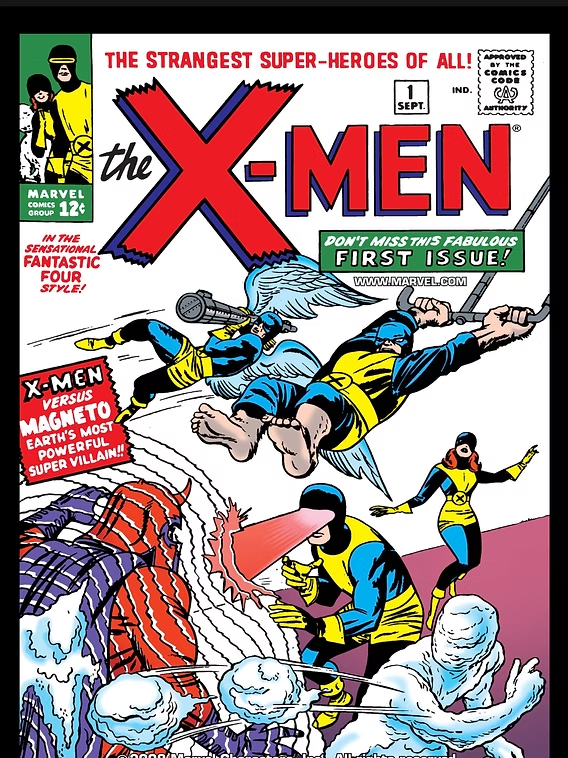
When X-Men #1 hit stands in September 1963, Jean Grey was there from the very beginning. Introduced under the codename Marvel Girl, she was one of the original five students at Xavier’s school alongside Scott Summers (Cyclops), Hank McCoy (Beast), Warren Worthington III (Angel), and Bobby Drake (Iceman). She was the only woman on the team, and while the era’s writing didn’t always serve her as well as it should have, her presence was foundational.
Those early issues established the X-Men’s core dynamic as a found family of young mutants learning to use their powers while navigating a world that feared them. Jean grew alongside the rest of the team, expanding her telekinetic skill, sharpening her telepathy, and slowly beginning to test the edges of what she could do. She was, even then, clearly the most naturally gifted of the group.
Jean and Scott
The relationship between Jean Grey and Scott Summers is one of the great love stories in comics. Even when ripped apart by death or other circumstances, they always come back together. They were drawn to each other almost immediately, though neither was particularly good at saying so at first. Scott stoic and broody, burdened by the weight of his uncontrollable optic blasts and emotionally guarded, found in Jean someone who understood him without needing him to explain himself. Jean, warm and deeply empathetic, found in Scott a steadiness that grounded her.
Their relationship deepened over years of stories and was the emotional backbone of the X-Men through most of the team’s early tales. It also helped set the stage for one of the greatest stories in comics history.

The Phoenix Saga
The story that changed everything began in Uncanny X-Men #101 (1976). The X-Men, returning from a mission in space, were forced to fly their shuttle through a deadly solar radiation storm. Jean, unwilling to let her teammates die when she could do something about it, took the controls herself and absorbed a lethal dose of radiation in the process.
She should have died.
Instead, Jean emerged from the crash transformed. More powerful than she had ever been and blazing with cosmic energy. Rising in the air, she called herself Phoenix.
This wasn’t just a new power level. It was a new identity, a new chapter, and for readers at the time, something that felt genuinely seismic. The Phoenix Saga that followed across Uncanny X-Men #101–108 is widely regarded as one of the best runs in the history of the medium. Jean was at the center of it all, commanding power as one of Marvel’s cosmic heroes, but still unmistakably, being Jean.

Dark Phoenix
But power on that scale comes with a cost.
The X-Men’s enemies recognized what Jean had become, and a villainous organization known as the Hellfire Club made her the target of a calculated psychic manipulation. The mutant Mastermind used his illusion-casting abilities to slowly erode Jean’s sense of self, pulling her deeper into darkness until the person inside became unrecognizable.
What emerged was the Dark Phoenix.
Uncanny X-Men #135–137 (1980) told the story of her fall and its aftermath in three devastating issues. The Dark Phoenix consumed a star, destroying an entire inhabited solar system in the process. The Shi’ar Empire, a galactic civilization with the power to match, declared her a threat to all life and demanded her execution. The X-Men stood in the way, fighting in vain to save her.
Scott fought for her. And Jean, in one of the most famous moments in comics history, chose to end it herself rather than risk the possibility that the darkness could resurface and she could hurt anyone else.
She died on the moon in 1980 and it broke readers.

She Comes Back (Obviously)
Death in comics is rarely permanent, especially when your name is Phoenix. But Jean Grey’s returns have always felt earned in a way that many resurrections don’t, largely because the stories surrounding them grapple with what it means.
The explanation that eventually emerged for what Dark Phoenix did gave writers a framework for bringing her back without simply undoing the tragedy. Jean returned in the mid-1980s as a founding member of X-Factor, a team she formed with the original five X-Men. She and Scott were reunited and they eventually married. Together they faced death countless times and survived.
As a telepath and telekinetic operating at full power, she is one of the most dangerous individuals on Earth. As the Phoenix, she operates on an entirely different scale, practically beyond death. But what makes Jean Grey matter isn’t just the power. It’s what she represents within the group.

The Heart of the X-Men
Jean is, in many ways, the moral and emotional center of the X-Men. Not the strategist like Scott. Not the conscience in the strictest sense of Charles. Jean is the heart. She’s the one who feels everything most acutely, who cares most openly, and who reminds the team, in their darkest moments, why they do what they do and that there’s always a way to come back.
For readers who are just now discovering the X-Men, her story is a rollercoaster. Jean’s relationship with her powers and the people around her take you to places you never thought you’d go for better or worse. She’s a character who’s just as empathetic and passionate as she is stubborn and rageful, but the X-Men wouldn’t be who they are without her. That’s Jean Grey.


